Magnesium alloys are among the most promising materials in the lightweighting toolbox. They’re low density, highly castable, and can be thixomolded into complex shapes that serve automotive, electronics, and wearable device applications. But magnesium has a well-known weakness: corrosion. In harsh environments, or when in contact with other metals, unprotected magnesium alloys degrade quickly, limiting where and how they can be used.
Xtalic addresses this challenge directly with XTALIUM®, a patented nanostructured aluminum-manganese alloy coating that gives magnesium the corrosion protection it needs without sacrificing the properties that make it valuable in the first place.
Contents
The Problem with Protecting Magnesium
Coating magnesium isn’t straightforward. The alloy’s mixed-phase microstructure makes surface activation for plating difficult, and many conventional activation chemistries are simply too aggressive for magnesium substrates. Achieving a smooth, uniform surface without mechanical polishing adds further complexity. Traditional solutions like paint, electrocoat, and metal arc oxidation coatings offer some protection but come with trade-offs in conductivity, thickness, and thermal performance.
A Three-Layer Solution
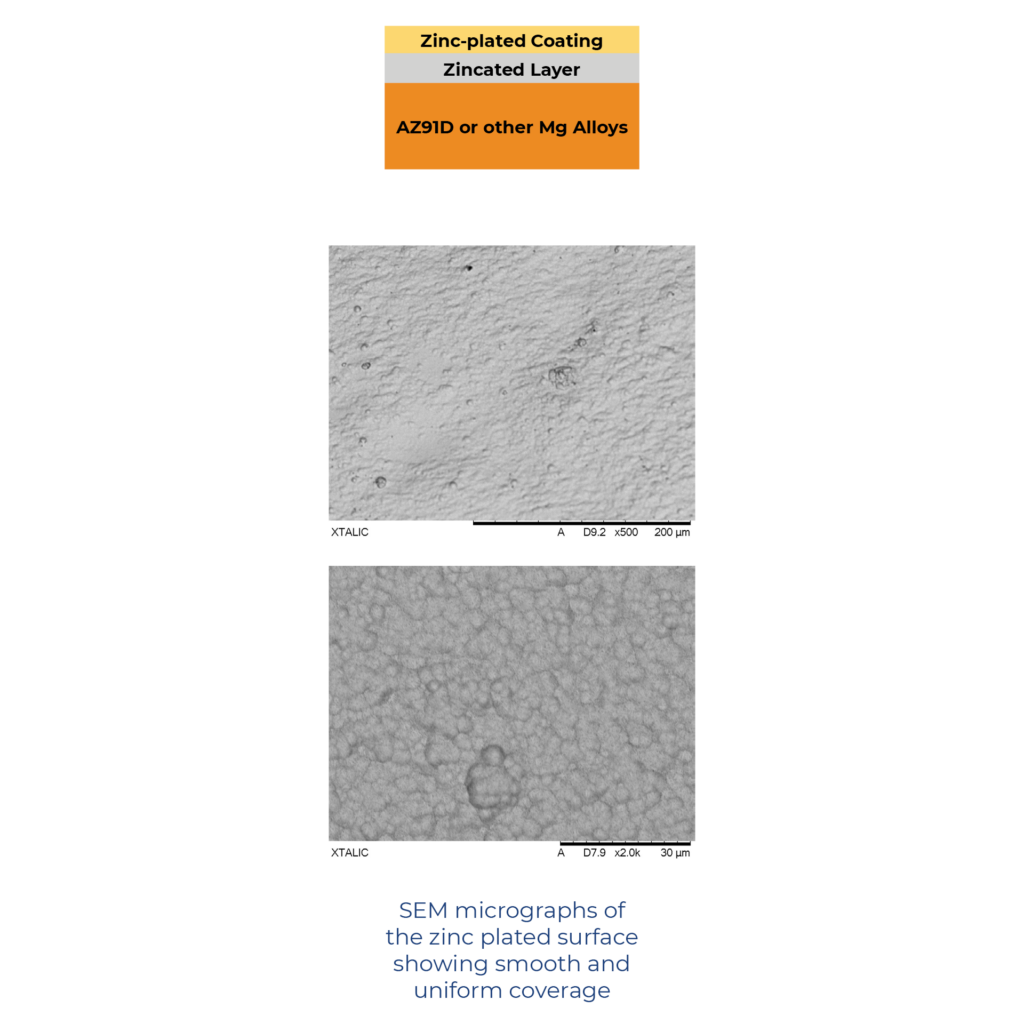
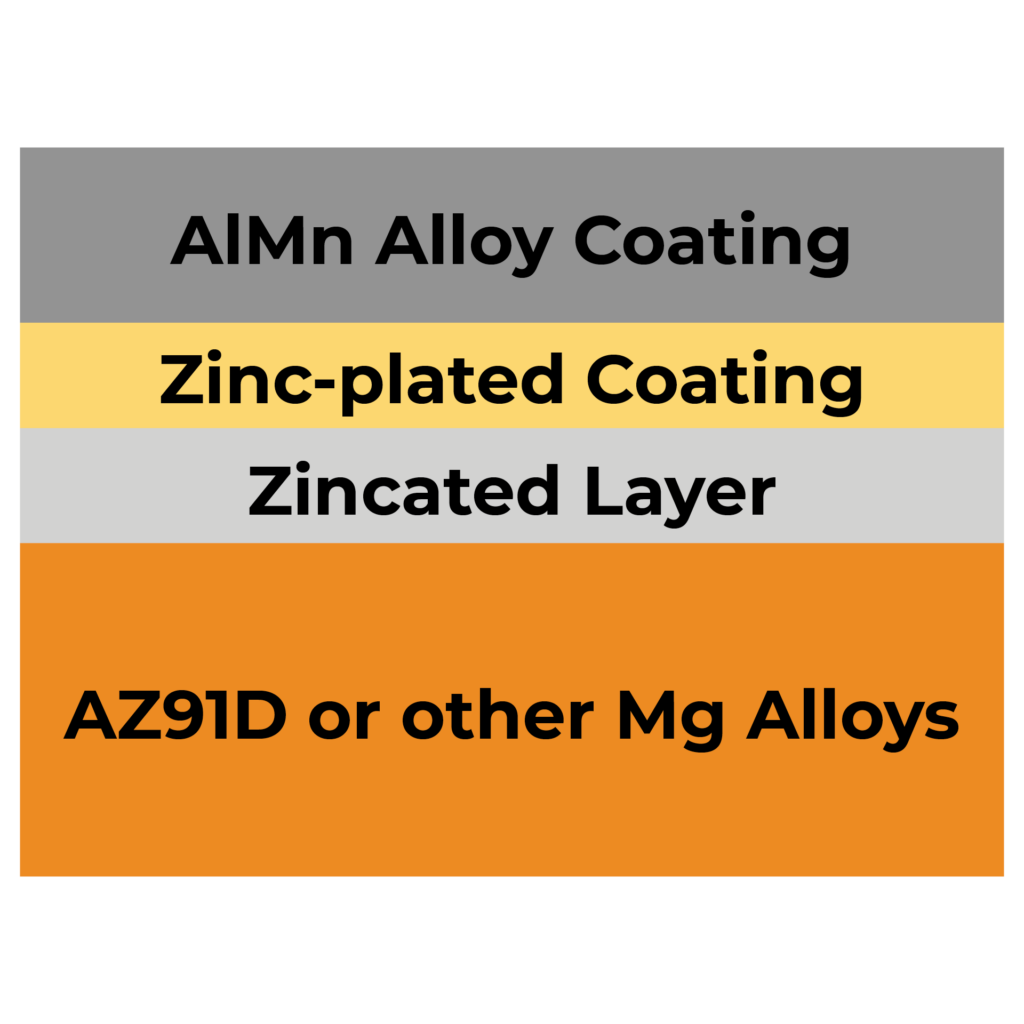
Xtalic engineered a three-layer coating architecture applied directly to AZ91D and other magnesium alloys.
Activation and Zincation
The magnesium surface is first activated using a novel fluoride-based chemistry, then zincated to create a smooth, continuous zinc layer.

Zinc Electrodeposition
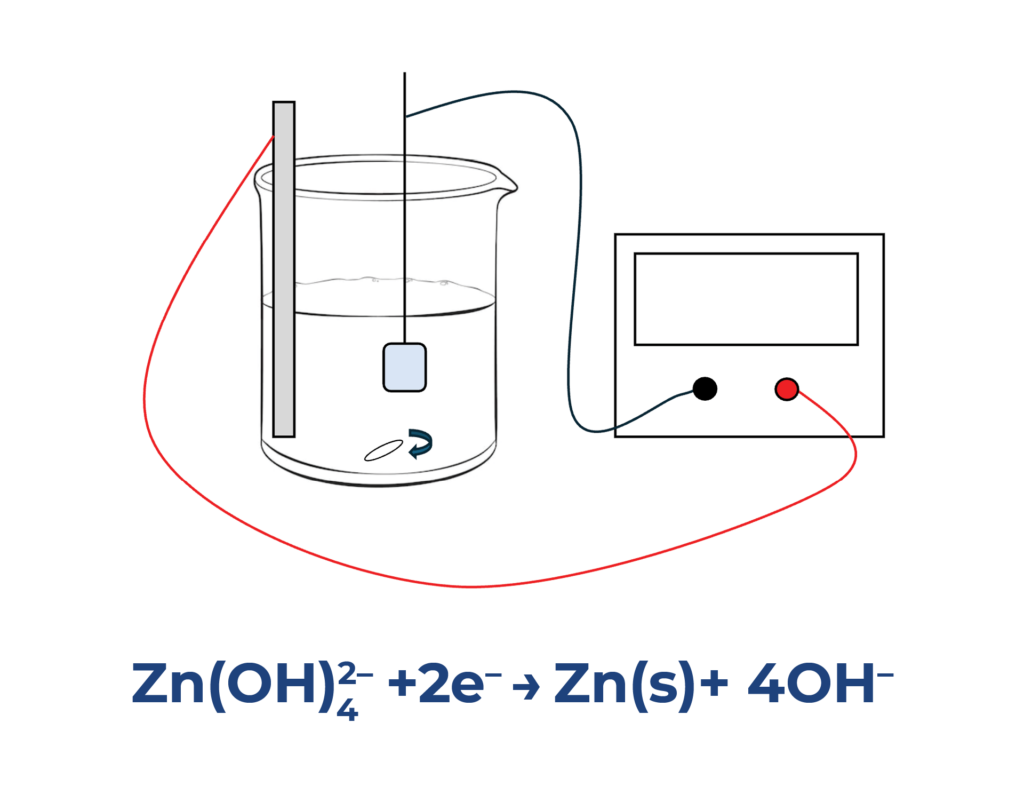
A secondary zinc plating step further smooths and seals the surface, creating the clean interface needed for consistent aluminum alloy adhesion across the part. This intermediate zinc layer provides an unexpected boost in performance which is critical since it protects the magnesium from subsequent plating chemistries and provides a uniform foundation for the aluminum alloy plating above it. The zinc deposition process uses a caustic bath at 20 mA/cm² for approximately 10 minutes, adding just 3–8 µm with minimal weight gain.
Nanocrystalline Aluminum-Manganese Electrodeposition (XTALIUM)
The final layer is where the performance is delivered. An aluminum-manganese alloy containing approximately 8 atomic percent manganese is deposited from an ionic liquid electrolyte at thicknesses ranging from 5 to 50 µm. The manganese atoms self-assemble at the grain boundaries, thermodynamically stabilizing the nanocrystalline grain structure. Atom Probe Microscopy (APM) is used to confirm the segregation of the Mn atoms to the grain boundaries, while Transmission Electron Microscopy (TEM) reveals the nanocrystalline grain structure of the alloy.

What the Coating Delivers
The resulting metallic Al-Mn coating is thin, hard, durable, and it brings a combination of properties that paint and anodizing simply cannot match.
- Corrosion resistance: ASTM B117 salt spray performance scales with coating thickness, reaching up to 5,000 hours of protection
- Hardness: 300 HV Vickers, significantly harder than conventional aluminum coatings and harder than the base Mg alloy.
- Thermal stability: the thermodynamically stabilized nanocrystalline structure resists degradation at elevated temperatures up to 300°C.
- Cosmetic quality: a bright, consistent finish (L, a*, b*: 91, 0.07, -0.25) suitable for visible consumer-facing components
- Nickel-free and low specific gravity: meeting increasingly common nickel restrictions in wearables and consumer electronics while adding minimal weight
The coating can also be hard anodized after deposition, opening an additional pathway for surface engineering depending on application requirements.

Why It Matters for Lightweighting
The case for magnesium in lightweighting is strong, but only if the corrosion problem is solved reliably at scale. Every kilogram removed from an automotive structure, aerospace assembly, robotics or consumer device has downstream benefits in energy efficiency, range, and performance. Xtalic’s nanostructured aluminum alloy coating (XTALIUM) has the capability to make magnesium a viable choice in demanding environments where it would otherwise be disqualified, effectively expanding the design space for engineers working on next-generation lightweight systems.
The Xtalic Approach
What makes this coating system distinctive isn’t just the performance data, it’s the underlying materials science. Like all of Xtalic’s alloy systems, the Al-Mn coating is engineered at the atomic level. The result is a coating whose properties are durable by design, not by chance. Learn more about XTALIUM.