Most materials companies describe what their materials can do for alloy development. Fewer can articulate how they get from customer conversation to a fully qualified alloy running on a production line. For over two decades, Xtalic has built an end-to-end capability that takes a customer’s most demanding alloy development challenge and moves it systematically to commercialization.
Contents
Alloy Development Starts With the Customer’s Roadmap
Every customer interaction begins with a product roadmap discussion rather than a product catalog. Our engineers sit with customers to understand their technology trajectory, the performance gaps they need to close, and the constraints they are working within.
- What features does the next product need to deliver?
- What is the current material failing to do?
- Where is the supply chain creating risk or cost exposure?
This is not a sales conversation, it’s an engineering one. Xtalic’s materials design experts invest the time to understand not just the immediate problem but the fundamental need, because the right alloy for today’s product may not be the right alloy for the one launching three years from now. That roadmap understanding is what allows Xtalic to design materials that solve the problem that matters most, not simply the one that is most visible at the outset.
A Design Platform Built on Materials Science
Once the need is clearly defined, Xtalic designs the alloy using our proprietary computational materials design platform, GBBS. Built on technology originally developed at MIT, the platform enables the team to engineer and optimize the corrosion resistance, hardness, and thermal stability properties of metals at the atomic level. By controlling grain size and structure, we can design alloys that outperform conventional alloys.
Traditional alloy development relies on testing material after material until something works. This method is slow, costly, and provides no guarantee of arriving at an optimal solution. Xtalic’s computational materials design platform replaces that process with a quantum accurate model-driven approach. We identify key performance indicators, explore the solution space computationally, and narrow the field to a small set of high-probability candidates before a single electrolyte is mixed. The result is a significantly shorter path from problem definition to working material.
A Path from Concept to Product
The path from material challenge to product continues in the laboratory at the beaker level. Our team rapidly evaluates alloy candidates, fine tunes the composition, and identifies the process formulation that best meets the customer’s technical requirements. Small test tabs enable fast experimentation across a wide range of variables without committing to larger production runs. This phase is designed to narrow the field quickly before resources are invested and scaled-up.
Once a promising composition is identified, the process moves to a larger capacity to mimic the conditions under which the customer will eventually use the material. The team verifies not only that the alloy performs in isolation, but that the value proposition holds at a scale more representative of real-world production. Adjustments are made, composition is refined, and the material is validated against the performance targets established.
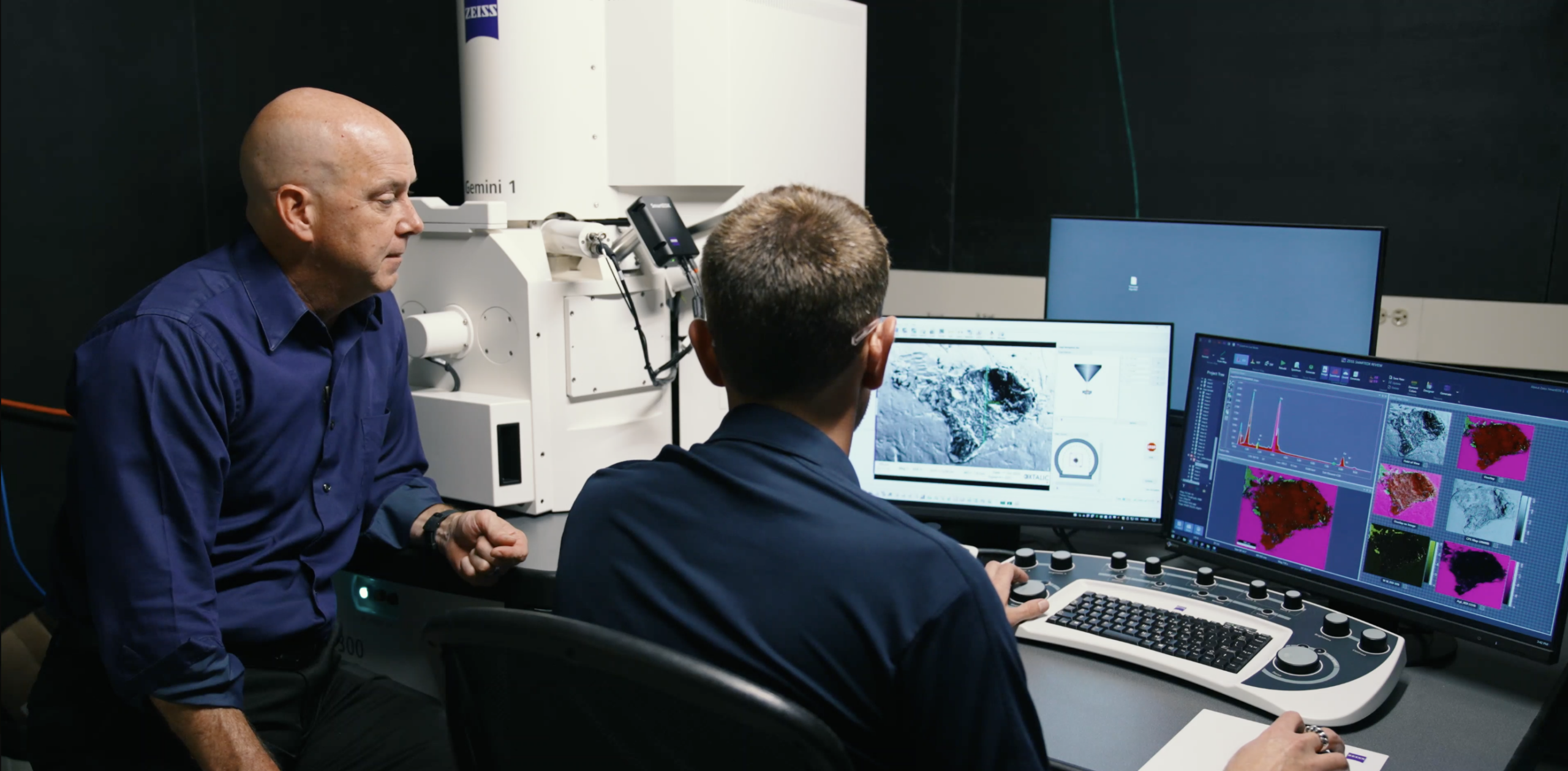
Validation at this stage is rigorous. We use fundamental materials characterization tools including scanning electron microscopy, atom probe tomography and x-ray crystallography to confirm that the alloy being produced matches the one that was designed. Performance testing follows, covering salt spray for corrosion resistance, mixed flowing gas for connector applications, and nanoindentation hardness, tensile, and wear performance evaluation. Every relevant industry standard is applied before the material advances to the next stage.
Performance in the Production Environment
One of the most significant differentiators in Xtalic’s process is what happens after laboratory validation. Rather than handing a qualified chemistry to the customer and leaving them to integrate it into their production line independently, we scale the process internally using pilot-scale equipment that replicates the customer’s manufacturing environment as closely as possible.
Our pilot line capability includes tanks built to handle up to 200 liters, along with reel-to-reel pilot line, barrel plating, and rack capability. These are designed to replicate the conditions customers will encounter in high-volume production. Plating rate, cost efficiency, and process stability are proven in this environment before any production commitment is made.
Two Facilities, One Integrated Workflow for Alloy Development
Our headquarters in Marlborough, Massachusetts has been at the center for new alloy development and customer collaboration for more than two decades. It is where roadmapping conversations take place, where new chemistries are developed and characterized, and where the full range of sampling capabilities are available for product-level testing and scale-up.
In 2025, Xtalic opened a new 700-square-meter Technical Center in Shenzhen, China, significantly expanding our ability to support customers. The Technical Center features a full-scale reel-to-reel pilot plating line, electroplating development labs, analytical and wet chemistry capabilities, and on-site technical support teams together under one roof, placing them directly adjacent to the manufacturing hubs they serve.
Together, the two Xtalic facilities create an integrated workflow that shortens the path from concept to commercialization, reduces development cycle time, and enables customers to evaluate, qualify, and scale new materials.
On-Site Support Through Production
When a customer’s production line is ready to run an Xtalic alloy, the work does not stop at material delivery. Our engineers are present to address issues in real time, optimize process parameters, and ensure that the material performance validated in development transfers fully to the finished product at volume.
We have built a system to address alloy development for the most demanding applications. It is a repeatable, validated, globally supported system that takes a customer’s hardest materials challenge and delivers a production-ready solution. From the first roadmap conversation to on-site production support, every step is designed to reduce risk, compress timelines, and ensure performance and commercialization.